The Missing Life


We will be remembered,
Only after we leave this World,
That is too for a short while,

And It's a bitter truth of our lives!

Yes it's the society we live in,
The surroundings we built in ages,
Believing in the unnatural made system,
Fighting within ourselves for inner freedom!

Gone are the childhood days,
Most of our parents already left,
We remember them the day they exit,
And we miss them when they're away!

We forget to be with them,
Each passing days of our lives,
Because we are after chasing our dreams,
The inside is all void like an empty beehive!

Parents we become,
We leave our children on their own,
We are strict, either careless to go beyond,
And we pretend to be engaged for their life!

We send our troops in war,
They sacrifice their lives for a country,
Their medals of bravery are at graveyard,
Aren't it be given before their defeated victory?

Love and compassion we buried,
In the name of power, politics and ego,
Life we didn't really live but just hurried,
We missed the life itself and letting it go!

The road we travelled is more outside,
Than the ones we did inside within us,
For we never kept our selfish desire aside,
What a missing life we have by ourselves!


My Mysterious Love


My special love,
Come over me,
I  am waiting for you,
Near this small lake view.

I wana hold your hand,
And grip in your palm,
Close my eyes and calm,
For I wana dive in your heart.

Oh dear don't make me wait,
For there is no much time left.
Life Is short for us to waste,
Run and embrace me dear.

I am all yours by your side,
Don't regret when I'm gone,
Love me now and not in future,
For there is no moment like better.

I am overwhelmed by your love ,
I will Always love to love you,
Whenever and where my dear,
Come let's make love without fear.

Oh my love please come,
Don't make me wait so long,
My soul is ready to merge thy soul,
For I want to be a part of you forever.

Come close your eyes,
And kiss me over,
My lips are waiting for yours,
For you taste so loving!

Hold me tight,
And never let me go,
I wana hold you back,
And kiss you long and deep!

Slowly we will dissolve,
In each other's arm and body,
Till we meet inside soul,
For we belong to each other my love!

World Environment Day


We have Only One Earth,
Let's see through our inner eye,
And protect wisely from our heart,
For we have little time left to say good bye!

We came a long way,
In this journey of celebration, 
Yet we couldn't keep our greed at bay,
Exploiting her in the name of conservation!

Five decades of journey,
What did we achieve from the plan?
May be few of them and rest are memory, 
For we occupied all space both in air and land!

We are after morden life,
Never foreseeing the nature in truth,
Few minds realize to the path of true light,
And we are still fine with the tree with no fruit!

Let's act in our best,
To implement the plans that was written,
Right from the kitchen to industries' waste,
For we ought to pass this legacy to our children!

Black-headed Cuckooshrike (Lalage melanoptera) first record in Bhutan


On 17th May 2021, I sighted Black-headed Cuckooshrike in Nyoenpaling (Pugli-B), Samtse. I heard the call for the first time when I was working in my backyard kitchen garden. A few moments later, it showed up on a leafy Teak tree Tectona grandis. The gloomy weather affected my vision, and I thought the bird was Sultan Tit Melanochlora sultanea. The invasive birds around, the Red-vented Bulbul and a few Drongo species were territorial and restricted its entry into their area.
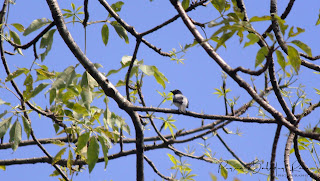

The next day, I saw it again perching on a canopy tree near my kitchen garden. I could photograph its underparts and also recorded its call. I reviewed the photograph, but it appeared to be Large Woodshrike Tephrodornis virgatus and not Sultan Tit as the gloomy weather falsified white belly as yellow the previous day. It   did not convince me owing to a poor photograph. I shared the call recording and the photograph in the Dragon Birding Amigos (DBA) Facebook Messenger group comprising of avid birding circles of Samtse. Since the photograph did not show prominent features of the bird, and call recording was    not clear and audible, members agreed to Large Woodshrike.

The call sounded new to me, so I kept my eyes on it. On 19th May 2021 at 1400 hours (local time), I could take several photographs while it was perching on the same tree-Teak. Later, I shared the photographs in the DBA Facebook Messenger group for identification. The DBA members thoroughly crosschecked the visual identification-dark slate-grey head, neck and upper breast, pale grey mantle and buff-white underparts, wings are darker grey than mantle, all pointing towards a male Black-headed Cuckooshrike. It was not possible to determine the age, but the visual    identification features showed it was an adult species. Thus, the DBA members confirmed it as Black-headed Cuckooshrike Lalage melanoptera. I photographed it at PCAL Pugli colony, Nyoenpaling (Pugli B), Phuntshopelri, Samtse (26°49’26.68” N 89°13’33.55” E).

After discussion with the DBA group, I shared the same photo in the Birds of Bhutan (BoB) Facebook Messenger group. The members of BoB (Bhutan BirdLife Society) not only confirmed it as the correct ID but also a new species in the country. As per the eBird Observation Dataset (n.d.), the closest record of this bird, to Bhutan is a record from Darjeeling (27.1N, 88.7E) and Puruliya (23.3N, 86.0E) in West Bengal, India in 2015 and 2019, respectively. According to the Bird Life International (2017), this species has a stable population trend and evaluated as Least Concern under International Union for Conservation of Nature (IUCN) status.

The Black-headed Cuckooshrike Lalage melanoptera (Rüppell, 1839) is a species of cuckooshrike found in south and south-east Asia (Wikipedia, 2021). It breeds in northern India (in Punjab and Uttar Pradesh) and Myanmar (avibase, n.d.). According to Barooah & Sarma (2016), it is found from Mount Abu through Sambar in Rajasthan to Kangra in Himachal Pradesh. It is a migratory bird in Assam. It is also found in Bangladesh and Sri Lanka. It habitats mostly in light deciduous forests and open broadleaved secondary growth forests in the plains and hills up to 2,000 masl (India Biodiversity Portal, n.d.).

The second record was also from the same place, Nyoenpaling B (Pugli) on early morning of April 6, 2022 at 6:15 am. It was with its loud and clear whistling song twe..twe..twee......tweeee....tweee...in the backyard garden. It then flew to the Khair tree and taller canopy of Teak tree near by. It usually takes a short flight from perching tree to other tree frequently without staying much in the same canopy. Its mostly seen flying tree to tree in search of its prey like insects and caterpillar in the tree leaves. They occasionally feeds on fruits and berries but not observed in its first record place at Noyenpaling (Pugli) for the same as it was observed only looking for insects or beetles in the leaves. 

The third record was also in the same month at the same location on April 23, 2022 at 3:27 pm with my friend Mr.Tashi Dorji, Sr.Forester, Tading Beat Office, Samtse. It was frequenting the same canopy of Khair trees top with its call in breaks of one or two hours. We assumed its nesting around but there was only a lone male count as in the first record. This year it visited quite early by a month plus than it first record last year. However, we cant rule out the exact month of its short migration to this place. Last year, it was for a week or two after its first record in the area. However, this time, it was around till last week of May, 2022 from its first visit of the season in first week of April, 2022. It could be still around, since it is a lone male count till date in the area and is observed only after its call. 

It is mostly seen perching in high canopy and make its call. During its call, it tend to perch longer time in same place and takes a short flight frequently. It is seen active in morning with its call and in afternoon. The posture in its call with upward throat and beak to the sky is unique when it goes for a longer call in the day time or afternoon. During the day, it was observed preening and taking rest with some call in between for almost half an hour in the same perch. The bird is seen chased away often by Drongo and Bulbul for being new in the area. 


Pugli River-River Pugli!


Thy name be perfect pronounced,
For thou art manifest in profound.
Seasons seldom thee visit plains,
Yet thee never cease to flow again!

Thy presence significant for ages,
Though thou course took changes.
Thee kept thy promise for eternal,
For thou art exist pure and natural!

Alas no more is thy fresh channel,
Those that carried alluvial mineral.
No more is those fertile paddy field,
For there stand tall wall without yield!

Insecure we became with thy purity,
By our greed and lack of true clarity,
For thy source exploited to destiny,
Fools we are to claim for economy!

Thy banks and beds are unearthed,
Reason we spell to tame thy wrath,
Like vultures in the carcass we feed,
Defending we are with our own creed!

Thy creation of those giant mountains,
Will soon lose its natural fountains,
For thou art been disturbed permanently,
And never again that be so heavenly!

Thee exists just by thy name for plenty,
For only few know thy eternal  beauty.
Taking a walk by thy side is romantic,
As thy little waves sound so fantastic!

Those algae’s fresh smell up to nostrils,
Like aroma of love that my heart thrills.
Tiny aquatic lives thee braces in thine,
Along with birds around thrive like mine!


Thee possess all qualities one may own,

But no one behold thy true value beyond.

Thy life at source we take in each droplet,

More precious thy drop to diamond bracelet!


Thy beds are being cozy yet thee can’t sleep,

For we made it into bleak vast drain so deep.

Thou art beautiful in all for it would be history,

Thee shall someday undeniably wakeup in glory! 


The Bhutanese Stock Market


The Bhutanese Stock Market is probably one of the smallest in the world and is governed by Royal Securities Exchange of Bhutan (RSEB). It is the only Stock Exchange in the country with the market capitalisation of about Nu.61billion . There are only 18 listed companies under RSEB as of 30 September 2024 (https://rsebl.org.bt/company.php). The size of the stock market is the size of the few Bhutanese who knows about stock market and only few does trade in secondary market. Many of the largest shareholders still wait for the good dividend rather than trading in secondary market.  Further, these lot may be not comfortable using the online trading through the app called mCaMS.

                Source: mCaMS trading history 

Not many gave much heed on Shares and Dividend chapter in high school and so did I. Those who took it not only for exam point of view but in practical aspect of life are the shareholders of listed companies. The few business elites and practical people owns the stock and majority of the Bhutanese are still not aware of the stock market. They must have heard it but never traded or owns one. The Shares which is the Initial Public offering (IPO) floated by listed companies to raise the capital is the primary market. Most of the Bhutanese shareholders own the primary market and wait for the good dividend. For example, some mining companies in the past gave huge dividend up to 500% in the final years of their lease period and the shareholders earned a good return on their investment. Those shareholders got an exit price of about Nu.532 per share when the company was formally closed down on expiry of the mining lease period.

This was seen a lucrative investment by the no risk takers later and all jumped into the business. Because most of us took it a risky business or may be with no idea in shares neglected the IPO and the company had to bring down the face value to attract the investors but only few with luck turned up to be successful later. Thus, declaration of huge dividend attracted more investors for new IPOs to be oversubscribed and the brokers had to limit to 500 or 1000 shares for individual. So, IPOs unlike in the past who could get more than 10,000 shares for an individual due to less investors are not so lucrative as new investors see it now. They are quite late but not too late as they have better opportunity in the secondary market.  

Secondary market is where the investors buy the shares from the other investors once the IPOs or new securities are sold in the primary market at the prevailing market price or the price agreed upon by both the sellers and buyers. The secondary market is regulated by Royal Securities Exchange of Bhutan (RSEB) and are facilitated for trade through the stock exchange brokers.  Bhutan National Bank Ltd. (BNBL), Bank of Bhutan (BoB) and Royal Insurance Corporation Ltd. (RICBL) are major stock brokers of the country. One can choose any of the above brokers depending upon your saving accounts in the respective banks for easy trading. I would recommend BNB if you have account as I feel comfortable and their service is reliable. The brokers keep 1% commission from each trading value which is reasonable and the transaction are completed within 2 to 3 working days.

In secondary market one doesn’t need to own a huge volume of shares and can fairly earn in trading if one keeps on tracking the trading trends of the companies. In fact, the earning is more in secondary market than in primary market through dividend now. The hefty return like in above classic scenario of 500% dividend was a history and may not repeat in Bhutanese stock market unless same promotor starts a new company in the same sector. Such high dividend gives higher return if one has large volume of shares but trading in secondary market with lesser volume and higher price always fetch good profit over a short period of time. For example, if one has 1500 shares and the company declares 65% dividend. The dividend amount would be Nu. 9,750 only. Now, if it is traded in the secondary market where one bought at Nu. 133.50 per share and sold at Nu. 154.40 per share after a week or a month as per market trading price. One gets a profit of Nu.20.9 per share and for 1500 shares, its Nu. 31,350 against the dividend amount of Nu. 9,750 only for same volume of shares in a year. Thus, it is the era of secondary market and not the safe saving in primary market in the hope of dividend. Buy small volume depending upon your affordability when market prices are less and sell when it goes up near the dividend declaration period.

It is good to have more volume of shares beyond 1000 for both dividend and secondary market trade price if one can afford. However, small volume can also be traded for significant amount of profit in short time and is worthwhile than playing a lottery. People always believed in the fact of its definition of legalized gambling and skeptical in investing in the stock market as it is still uncertain in the market price fluctuation. Nevertheless, one can still hold its face value amount even if the company failed to make profit and declare dividend for quite some time. Yes, it is obvious that many listed companies could not declare dividend since the pandemic and offered bonus shares to the shareholders while other offered right share issue. The bonus shares are directly allotted to the shareholders if company decides to issue in place of dividend while right shares issues are floated at the initial IPOs face value rate of Nu.10 per share. It is good to get the IPOs which are competitive market price than the higher secondary market price but as mentioned above one is limited to buy the large volume unlike in the past with only few investors. One has no limit in secondary market if you can get the ordered volumes from the sellers.   

The IPOs are normally off line through brokers in hard copy filled forms whereas the secondary shares are online through digital transaction which is popular these days. The secondary market trade also used to be off line in paper earlier but now people prefer business in their fingertips. The secondary market shares auctions also happen online in the RSEBL website with their fixed base price. For example, the RICBL and BNBL secondary shares last year was oversubscribed and had to refloat the shares for second time. This means people are slowly knowing the stock market but still participate less in the secondary market share trading. Majority of the people are still with the concept of dividend and long term investment rather than trading weekly or monthly for more profit.

To start the secondary market trading, one can simply choose the broker and open the CD account for trading. The brokers will help in filling the form and submit to RSEB for the credentials. They usually take 2 to 3 working days to create the CD account of the applicant and issue the user name and temporary password. They will mail the credentials and one need to change the password through the link in the mail. After the successful change of password from the link, one can login to the mCaMS app with that user name and new password. One can down load the above app from Play Store or App Store. The trading will be on the screen and in the fingertips. Its handy and reliable app. One can start trading right away if there are shares for trade. One can sell and buy in few press and the executed orders will be displayed in the app page. The transaction of the traded value will be completed in 2 to 3 working days or even earlier sometimes in the registered saving account.  One best feature of the app is, there will be already a loaded amount in your CD account for trading depending upon your trading trend or your requested amount. They will trade from the CD account and later on debit or credit from the registered account. One has to keep the sufficient amount for trading. This is the beauty of this app and has made it digital transaction more efficient.

However, the Bhutanese investors are yet to grow in the stock market and many lack awareness in the business. There are lots of unclaimed dividends and slowly shareholders are following up with their unclaimed dividends. The concerned companies and brokers claim that they could not deposit to the shareholders account due to non-availability of the shareholders account and address details.  Further, most new companies decline floating shares and they go for bond which people don’t prefer. The company might be fearing for dividend claim by shareholders and play safe in giving some fixed interest for the bond which may not be fair for the investors. Some SOEs companies were supposed to float IPOs as per the auction clauses but that didn’t happen which was another blow for the ready and new investors. The IPOs must be mandatory for all SOEs and Private owned new companies in future for the growth of Bhutanese Stock Market.

The Broom Stick-The Flowers that Sweeps

The Tiger Grass commonly known as Broom Grass or Broom Stick plant is least bothered plant in the family of Grass except for few farmers who harvest it. It can be seen plenty along the farm road and highways in landslides areas to degraded areas. 


It's an abandoned flower in the degraded areas and normally used for sweeping the floor as Broom stick instead of offerings in the altars like other flower species. However, the merit of this sweeping flower is more than those colorful flowers in the altar which will be replaced next morning with fresh plucked ones.  

Nature has made evry species unique and human by chance put into use in its best purpose. This unique Grass flowers make the best Broom stick for sweeping and keeping our traditional home clean. The Broom is eco-friendly and easily available in the near by forest. One can grow in the small space in the kitchen garden with least care and mantainence. 

This Tiger Grass also know as Amliso in Lhotsham or Nepali is drought resistant Grass can be seen in degraded and open dry area. It is a soil binders in reclamation poor soil area which means the grass can adapt easily in such environment and make the area fertile for other Grass or trees to regenerate. It is not a invasive plant or grass so is highly recommended in poor soil area. For example, the plantation in mining reclamation area can kick start with this Tiger Grass for immediate soil improvement. It's roots can hold the soil and prevent it from soil erosion and slides in some extent. 


It can be planted in the pre-monsoon season during April-June for higher survival rate. The sapling can be taken from the mother Grass uprooting by spade or fork. One can also bring the sapling from the wild and directly plant it in the right season. Make the proper pit and cover with good top soil for fast growth for harvest in a year or two. Water it after planting the saplings if it is dry and not raining. 


The harvest season is in the winter which ranges from January to March. However, the harvest of the flower must be at right maturity for the best product. Not immature neither too matured. It has to be soft not too hard which breaks if it reaches the ultimate maturity. One can pull it out from the stem or cut at the base of the panicles and separate from the stem. 


The separated panicles can be properly dried. After drying, some flowers seeds should be rubbed on the floor by hands or feet  and throw away for proper softening of the Broom. The mother stem can be cut above the root soil and can be used as support for beans and other climbers vegetables. The plant after being properly cut for harvesting can be burnt with  dry leaves or twigs for proper growth of the new shoot for next season. The burnt ashes will give good soil conditions with required nitrogen for its growth for more product in the next lot.


Farmers can earn passive income from the Broom harvest even from a small plantations area. One farmer shares that he earned about Nu.1600/- selling about 80 pieces of Broom stick he harvested from his kitchen garden. Another farmer who has planted in larger space earns more than Nu.100,000/- in a year. 


Simple Recipes for Puchkas or Panipuri at your Home

One of the best street foods in the Jaigoan footpath next to stall momo is Puchkas or Panipuri. The Bhutanese Panipuri lovers might be as eager as Jaigoan residents for the Bhutan Gate to open which was shut since the pandemic hit the country in March, 2020. The sour soup and spicy hot potatoes mashed pulp leaves every lovers mouth wet despite its kitchen hygiene on the open street.

I was always skeptical over the hygiene factor of this particular street food when I saw first time in Jaigoan street. However, it became one of my favorite snack on my way back from college to dormitory Hall 7. I used to wait in a long queue for my turn to get a piece on the paper plate. The last dry piece or Sukha used to be special after the last piece of one plate serve. 


These days one can find the Puchkas in almost all small restaurants of Phuntsholing Town and capital town Thimphu. But the original factory made taste still exist in Jaigoan footpath in the hands of those stall owners. You can find almost an equivalent quality and hygienic Panipuri in capital town just next to Pelwang Photo Studio at ground floor.
https://www.facebook.com/BHUTANFOOD/posts/jangsemmondaycheck-out-pucka-corner-on-the-top-floor-of-pelwang-photo-studio-bui/632708491452636/. They use gloves and clean containers like that in Sheetal Residency Family Restaurant in Jaigoan 
https://www.facebook.com/Sheetalresidencyjaigaon/. The per plate price is Nu.50 and they serve you other items like Chaat and coffee too. 

Nevertheless, the food processing industries even if it's a small cup of tea keeps its brand image with the process hygiene and food safety. The process hygiene gets revealed unless one is involved in the process. So if you are a health conscious person, why can't you try yourself at home. Try to be your own chef and taste your own fingers.

Try out the these simple recipe at home which I tried.

1. Get the ready made ingredients of Puchkas from shop.


You will find the following spices in the packet!


2. Fry the potatoes chips that will pop-up into small puchka balls.


The Puchkas balls sometimes becomes big for small mouth.

3. Boil 4 to 5 pieces of potatoes.


4. Smash the potatoes into pulp.


5. Cut onions and tomatoes into small pieces and add green chilli or dry chilli.


6. Fry this onion, tomatoes and chilli for the taste or one can use the raw depending upon the choice of taste.


7. Mix the potatoes pulp and the fried paste.


8. Cut open the main soup powder and mix in the water properly.


9. Serve it on your plate and enjoy your Puchkas on your home table.


Kaabi Hung Mo Affnoi

 Malai Kaabi Huna Moncha  Ra Aafno  Dhun Sunna Moncha Ani Timro  Mon Chuna Moncha!  Malai Kaabi Huna Moncha  Kunai Din Timi Sanga Runa Monch...