Pugli River-River Pugli!


Thy name be perfect pronounced,
For thou art manifest in profound.
Seasons seldom thee visit plains,
Yet thee never cease to flow again!

Thy presence significant for ages,
Though thou course took changes.
Thee kept thy promise for eternal,
For thou art exist pure and natural!

Alas no more is thy fresh channel,
Those that carried alluvial mineral.
No more is those fertile paddy field,
For there stand tall wall without yield!

Insecure we became with thy purity,
By our greed and lack of true clarity,
For thy source exploited to destiny,
Fools we are to claim for economy!

Thy banks and beds are unearthed,
Reason we spell to tame thy wrath,
Like vultures in the carcass we feed,
Defending we are with our own creed!

Thy creation of those giant mountains,
Will soon lose its natural fountains,
For thou art been disturbed permanently,
And never again that be so heavenly!

Thee exists just by thy name for plenty,
For only few know thy eternal  beauty.
Taking a walk by thy side is romantic,
As thy little waves sound so fantastic!

Those algae’s fresh smell up to nostrils,
Like aroma of love that my heart thrills.
Tiny aquatic lives thee braces in thine,
Along with birds around thrive like mine!


Thee possess all qualities one may own,

But no one behold thy true value beyond.

Thy life at source we take in each droplet,

More precious thy drop to diamond bracelet!


Thy beds are being cozy yet thee can’t sleep,

For we made it into bleak vast drain so deep.

Thou art beautiful in all for it would be history,

Thee shall someday undeniably wakeup in glory! 


The Bhutanese Stock Market


The Bhutanese Stock Market is probably one of the smallest in the world and is governed by Royal Securities Exchange of Bhutan (RSEB). It is the only Stock Exchange in the country with the market capitalisation of about Nu.61billion . There are only 18 listed companies under RSEB as of 30 September 2024 (https://rsebl.org.bt/company.php). The size of the stock market is the size of the few Bhutanese who knows about stock market and only few does trade in secondary market. Many of the largest shareholders still wait for the good dividend rather than trading in secondary market.  Further, these lot may be not comfortable using the online trading through the app called mCaMS.

                Source: mCaMS trading history 

Not many gave much heed on Shares and Dividend chapter in high school and so did I. Those who took it not only for exam point of view but in practical aspect of life are the shareholders of listed companies. The few business elites and practical people owns the stock and majority of the Bhutanese are still not aware of the stock market. They must have heard it but never traded or owns one. The Shares which is the Initial Public offering (IPO) floated by listed companies to raise the capital is the primary market. Most of the Bhutanese shareholders own the primary market and wait for the good dividend. For example, some mining companies in the past gave huge dividend up to 500% in the final years of their lease period and the shareholders earned a good return on their investment. Those shareholders got an exit price of about Nu.532 per share when the company was formally closed down on expiry of the mining lease period.

This was seen a lucrative investment by the no risk takers later and all jumped into the business. Because most of us took it a risky business or may be with no idea in shares neglected the IPO and the company had to bring down the face value to attract the investors but only few with luck turned up to be successful later. Thus, declaration of huge dividend attracted more investors for new IPOs to be oversubscribed and the brokers had to limit to 500 or 1000 shares for individual. So, IPOs unlike in the past who could get more than 10,000 shares for an individual due to less investors are not so lucrative as new investors see it now. They are quite late but not too late as they have better opportunity in the secondary market.  

Secondary market is where the investors buy the shares from the other investors once the IPOs or new securities are sold in the primary market at the prevailing market price or the price agreed upon by both the sellers and buyers. The secondary market is regulated by Royal Securities Exchange of Bhutan (RSEB) and are facilitated for trade through the stock exchange brokers.  Bhutan National Bank Ltd. (BNBL), Bank of Bhutan (BoB) and Royal Insurance Corporation Ltd. (RICBL) are major stock brokers of the country. One can choose any of the above brokers depending upon your saving accounts in the respective banks for easy trading. I would recommend BNB if you have account as I feel comfortable and their service is reliable. The brokers keep 1% commission from each trading value which is reasonable and the transaction are completed within 2 to 3 working days.

In secondary market one doesn’t need to own a huge volume of shares and can fairly earn in trading if one keeps on tracking the trading trends of the companies. In fact, the earning is more in secondary market than in primary market through dividend now. The hefty return like in above classic scenario of 500% dividend was a history and may not repeat in Bhutanese stock market unless same promotor starts a new company in the same sector. Such high dividend gives higher return if one has large volume of shares but trading in secondary market with lesser volume and higher price always fetch good profit over a short period of time. For example, if one has 1500 shares and the company declares 65% dividend. The dividend amount would be Nu. 9,750 only. Now, if it is traded in the secondary market where one bought at Nu. 133.50 per share and sold at Nu. 154.40 per share after a week or a month as per market trading price. One gets a profit of Nu.20.9 per share and for 1500 shares, its Nu. 31,350 against the dividend amount of Nu. 9,750 only for same volume of shares in a year. Thus, it is the era of secondary market and not the safe saving in primary market in the hope of dividend. Buy small volume depending upon your affordability when market prices are less and sell when it goes up near the dividend declaration period.

It is good to have more volume of shares beyond 1000 for both dividend and secondary market trade price if one can afford. However, small volume can also be traded for significant amount of profit in short time and is worthwhile than playing a lottery. People always believed in the fact of its definition of legalized gambling and skeptical in investing in the stock market as it is still uncertain in the market price fluctuation. Nevertheless, one can still hold its face value amount even if the company failed to make profit and declare dividend for quite some time. Yes, it is obvious that many listed companies could not declare dividend since the pandemic and offered bonus shares to the shareholders while other offered right share issue. The bonus shares are directly allotted to the shareholders if company decides to issue in place of dividend while right shares issues are floated at the initial IPOs face value rate of Nu.10 per share. It is good to get the IPOs which are competitive market price than the higher secondary market price but as mentioned above one is limited to buy the large volume unlike in the past with only few investors. One has no limit in secondary market if you can get the ordered volumes from the sellers.   

The IPOs are normally off line through brokers in hard copy filled forms whereas the secondary shares are online through digital transaction which is popular these days. The secondary market trade also used to be off line in paper earlier but now people prefer business in their fingertips. The secondary market shares auctions also happen online in the RSEBL website with their fixed base price. For example, the RICBL and BNBL secondary shares last year was oversubscribed and had to refloat the shares for second time. This means people are slowly knowing the stock market but still participate less in the secondary market share trading. Majority of the people are still with the concept of dividend and long term investment rather than trading weekly or monthly for more profit.

To start the secondary market trading, one can simply choose the broker and open the CD account for trading. The brokers will help in filling the form and submit to RSEB for the credentials. They usually take 2 to 3 working days to create the CD account of the applicant and issue the user name and temporary password. They will mail the credentials and one need to change the password through the link in the mail. After the successful change of password from the link, one can login to the mCaMS app with that user name and new password. One can down load the above app from Play Store or App Store. The trading will be on the screen and in the fingertips. Its handy and reliable app. One can start trading right away if there are shares for trade. One can sell and buy in few press and the executed orders will be displayed in the app page. The transaction of the traded value will be completed in 2 to 3 working days or even earlier sometimes in the registered saving account.  One best feature of the app is, there will be already a loaded amount in your CD account for trading depending upon your trading trend or your requested amount. They will trade from the CD account and later on debit or credit from the registered account. One has to keep the sufficient amount for trading. This is the beauty of this app and has made it digital transaction more efficient.

However, the Bhutanese investors are yet to grow in the stock market and many lack awareness in the business. There are lots of unclaimed dividends and slowly shareholders are following up with their unclaimed dividends. The concerned companies and brokers claim that they could not deposit to the shareholders account due to non-availability of the shareholders account and address details.  Further, most new companies decline floating shares and they go for bond which people don’t prefer. The company might be fearing for dividend claim by shareholders and play safe in giving some fixed interest for the bond which may not be fair for the investors. Some SOEs companies were supposed to float IPOs as per the auction clauses but that didn’t happen which was another blow for the ready and new investors. The IPOs must be mandatory for all SOEs and Private owned new companies in future for the growth of Bhutanese Stock Market.

The Broom Stick-The Flowers that Sweeps

The Tiger Grass commonly known as Broom Grass or Broom Stick plant is least bothered plant in the family of Grass except for few farmers who harvest it. It can be seen plenty along the farm road and highways in landslides areas to degraded areas. 


It's an abandoned flower in the degraded areas and normally used for sweeping the floor as Broom stick instead of offerings in the altars like other flower species. However, the merit of this sweeping flower is more than those colorful flowers in the altar which will be replaced next morning with fresh plucked ones.  

Nature has made evry species unique and human by chance put into use in its best purpose. This unique Grass flowers make the best Broom stick for sweeping and keeping our traditional home clean. The Broom is eco-friendly and easily available in the near by forest. One can grow in the small space in the kitchen garden with least care and mantainence. 

This Tiger Grass also know as Amliso in Lhotsham or Nepali is drought resistant Grass can be seen in degraded and open dry area. It is a soil binders in reclamation poor soil area which means the grass can adapt easily in such environment and make the area fertile for other Grass or trees to regenerate. It is not a invasive plant or grass so is highly recommended in poor soil area. For example, the plantation in mining reclamation area can kick start with this Tiger Grass for immediate soil improvement. It's roots can hold the soil and prevent it from soil erosion and slides in some extent. 


It can be planted in the pre-monsoon season during April-June for higher survival rate. The sapling can be taken from the mother Grass uprooting by spade or fork. One can also bring the sapling from the wild and directly plant it in the right season. Make the proper pit and cover with good top soil for fast growth for harvest in a year or two. Water it after planting the saplings if it is dry and not raining. 


The harvest season is in the winter which ranges from January to March. However, the harvest of the flower must be at right maturity for the best product. Not immature neither too matured. It has to be soft not too hard which breaks if it reaches the ultimate maturity. One can pull it out from the stem or cut at the base of the panicles and separate from the stem. 


The separated panicles can be properly dried. After drying, some flowers seeds should be rubbed on the floor by hands or feet  and throw away for proper softening of the Broom. The mother stem can be cut above the root soil and can be used as support for beans and other climbers vegetables. The plant after being properly cut for harvesting can be burnt with  dry leaves or twigs for proper growth of the new shoot for next season. The burnt ashes will give good soil conditions with required nitrogen for its growth for more product in the next lot.


Farmers can earn passive income from the Broom harvest even from a small plantations area. One farmer shares that he earned about Nu.1600/- selling about 80 pieces of Broom stick he harvested from his kitchen garden. Another farmer who has planted in larger space earns more than Nu.100,000/- in a year. 


Simple Recipes for Puchkas or Panipuri at your Home

One of the best street foods in the Jaigoan footpath next to stall momo is Puchkas or Panipuri. The Bhutanese Panipuri lovers might be as eager as Jaigoan residents for the Bhutan Gate to open which was shut since the pandemic hit the country in March, 2020. The sour soup and spicy hot potatoes mashed pulp leaves every lovers mouth wet despite its kitchen hygiene on the open street.

I was always skeptical over the hygiene factor of this particular street food when I saw first time in Jaigoan street. However, it became one of my favorite snack on my way back from college to dormitory Hall 7. I used to wait in a long queue for my turn to get a piece on the paper plate. The last dry piece or Sukha used to be special after the last piece of one plate serve. 


These days one can find the Puchkas in almost all small restaurants of Phuntsholing Town and capital town Thimphu. But the original factory made taste still exist in Jaigoan footpath in the hands of those stall owners. You can find almost an equivalent quality and hygienic Panipuri in capital town just next to Pelwang Photo Studio at ground floor.
https://www.facebook.com/BHUTANFOOD/posts/jangsemmondaycheck-out-pucka-corner-on-the-top-floor-of-pelwang-photo-studio-bui/632708491452636/. They use gloves and clean containers like that in Sheetal Residency Family Restaurant in Jaigoan 
https://www.facebook.com/Sheetalresidencyjaigaon/. The per plate price is Nu.50 and they serve you other items like Chaat and coffee too. 

Nevertheless, the food processing industries even if it's a small cup of tea keeps its brand image with the process hygiene and food safety. The process hygiene gets revealed unless one is involved in the process. So if you are a health conscious person, why can't you try yourself at home. Try to be your own chef and taste your own fingers.

Try out the these simple recipe at home which I tried.

1. Get the ready made ingredients of Puchkas from shop.


You will find the following spices in the packet!


2. Fry the potatoes chips that will pop-up into small puchka balls.


The Puchkas balls sometimes becomes big for small mouth.

3. Boil 4 to 5 pieces of potatoes.


4. Smash the potatoes into pulp.


5. Cut onions and tomatoes into small pieces and add green chilli or dry chilli.


6. Fry this onion, tomatoes and chilli for the taste or one can use the raw depending upon the choice of taste.


7. Mix the potatoes pulp and the fried paste.


8. Cut open the main soup powder and mix in the water properly.


9. Serve it on your plate and enjoy your Puchkas on your home table.


Oscars 2022 Nominee- LUNANA: A YAK In The CLASSROOM


The world never expected that a Bhutanese Film Industry would tell the story of the small Himalayan Kingdom of Bhutan in the Oscars. The Bhutanese Drama Film made to the much awaited Oscars nomination 2022 final list along with other four films from hundreds others. It is the first ever Bhutanese film to be nominated for the Oscars award in the history of Bhutan and there are every chances that the trophy would come home.

Source: https://asianews.network/ 

The journey to the nomination for 94th Academy Awards was challenging right from the registration phase where Bhutan was not even in the list of countries applying for the nominations. The versatile Director & Producer of the film, Pawo Choyning Dorji shares in his interviews that he had to wait until the website was updated with our country name and language (Dzongkha) details at the final hour. While, the film has so far entered in 12 Internationals Film Festivals to winning The Audience Choice Award at the 31st Annual Palm Springs International Film Festival in 2020 since its debut in October, 2019.

LUNANA: A Yak in The Classroom will tell us the truth of finding the happiness in the light of darkness through the story of a young teacher who was placed in the world’s remotest school. At first he regrets coming to such a place with no basic amenities but slowly begins to love his students and the environment. However, his dreams to pursue his singing career in Australia haunts him inside. He leaves to his dream land breaking the hearts of his students especially of the little class captain Pem Zam. He becomes the best and favorite teacher of those innocent students and write him a letter to return to them in Spring.

In general, it’s about the happiness we seek within us in a GNH country, our education system and the young Bhutanese leaving for greener pastures in foreign land in pursuit of happiness and comfort. It’s the sad reality that hundreds of young and potential Bhutanese leaving amid the pandemic which might lead to the brain drain crisis sooner or later. Are we failing in the education or the system of education or in any field? Can we find more happiness in the dark valley of Lunana like those innocent children and the community living there for ages? The answer is big YES and Ugyen soon realizes to come back to embrace his beloved students and his secret admirer Saldon.

It’s about our tradition and culture. Ugyen refuses to offer the prayers to local deity on his way to school when his guide Michen suggest but he does on his way back to capital. He practices and sings Yak Lebi Lhadar a traditional song of Lunana Yak herders. He accepts the reception and see off simple ceremonies with prayers/songs and recall his guides Michen and Singye singing over the open jungle fire place on their 8 days’ perilous way to school while he was on the western music over the headphones. The Yak dung becomes the practical way of lighting a fire in a place where electricity has no place. The Yak Norbu inside the class room becomes the catchy title for the world but it has more to do with students, teacher and Saldon who gifts to Ugyen. It’s a symbol of love and bond between all of them.

It’s about the ever changing world of modernization into climate change and the environment. His guide Michen shares the declining snow line story over the peaks to valley that represent our pristine environment and nature with deep concern. Are we not responsible for the global warming and climate change? We all ought to be the environment champion to the world in all times to come. It is our personal to social to national to regional to global responsibility for the humanity. It’s also about the poverty line we normally ignore as in the movie with a child wearing a red plastic boot. Ugyen stares at the boot of a host child who was fondly wearing in the kitchen fire place as a guest with his guides on his way to school. While, the elderly people choose bare foot over any foot wear or expensive shoes walking in muds and thorns. Yet they are happy and contended but what about the lot those who don’t have proper clothing and foods? They need our helping hand and compassionate heart.

It’s about the leadership we need at the grassroots level as shown by Asha Gup (the village head). It’s not only about the qualification and highly trained leadership skills one poses but a simple hospitability and the cooperation we give to the other person on time of need. His timely help to put a wooden blackboard over the wall put smiles on Ugeyn and his students face. The Gups in our 205 gewogs has immense contributions in the communities especially for the schools as most of the extended class rooms and primary schools are under their jurisdiction for budget and developmental activities. My friend Jigme Jamtsho, an officiating principal of Bukey Primary School, Samtse is a living example and the Gup there who poses all these true qualities of leadership.

It’s about the passion of teaching and learning irrespective of the facilities in place. The skills to manage and learn with least resources. Ugyen sacrifices his paper curtain over the window and use it for his students. He signs for his students and the Yak Norbu finally. Are we chasing the wrong dreams and living the disguised reality? May be Yes because every one of us wanted to pursue a high profile job when we graduated from high school. However, we landed up in no choice option of teaching and other low profile jobs in the market where our focus and passion are compromised for quality. We are lately realizing the skill based education which is not too late for us.

And it’s about the burning passion of every child not just of the innocent Pem Zam to learn the every subject they ought to study. Their relationship as a teacher-student is amazing and the role of class captain by Pem Zam is the heart of the movie. This cute innocent girl with natural charisma is a born actor and simply authentic.

If Oscar award comes home this Monday on 28th March, 2022, the one criteria I would set for the win would be simplicity and authenticity of natural acting by every characters in the movie apart from the main themes. In life everything is beautiful when it is in natural state. We tend to seek the beauty and happiness in the fake and far world outside where every happiness and beauties lies within us.  

LUNANA: A Yak In The Classroom is a unique movie to outside world from the title itself but is a common quest of happiness for all as a human being. The movie location itself is chosen particularly at Lunana which means a dark valley where people’s perception of seeing the light is less but in reality the spark is within us. The metaphor of our lives played by the characters and the real lives of Lunana people in the movie is the truth and reality of all human being to be in constant state of happiness.

If Oscars had to see the technical criteria from filming and cinematography point of view, then also it’s nothing less in the making of the film. It was in fact filmed with the most challenging resources right from all crew members and the raw actors who has never faced a camera before. It was shot on the remotest village on solar powered battery without out much option to do recap and video editing often as required. The Director of the film shares that the toughest category of the film making is with animals and children where the center of attraction in the movie is by Pem Zam and the yak Norbu.

This is a must win Oscars movie for me in this over dreamy world of dreams, desires, power, ego, hatreds and war. We can be happy and contended in our small home and space. We don’t need big house or more money to shelter ourselves from the quest of happiness in faraway place as long as we are alive every moment. We don’t need so much modernized world of science and technology of AI and robotic to loose ourselves to the them sooner or later. We are already in the verge of extinction over our own discovery of bioscience and nuclear energy. We are choosing the wrong path against the nature in the name of technology. One can get the glimpse of this reality in this Oscar winning movie. Watch the movie , if you have not  and contemplate yourself.

Source: www.screendaily.com  


An Evening for a Bird- Webinar Series by Bhutan Birdlife Society (BBLS)


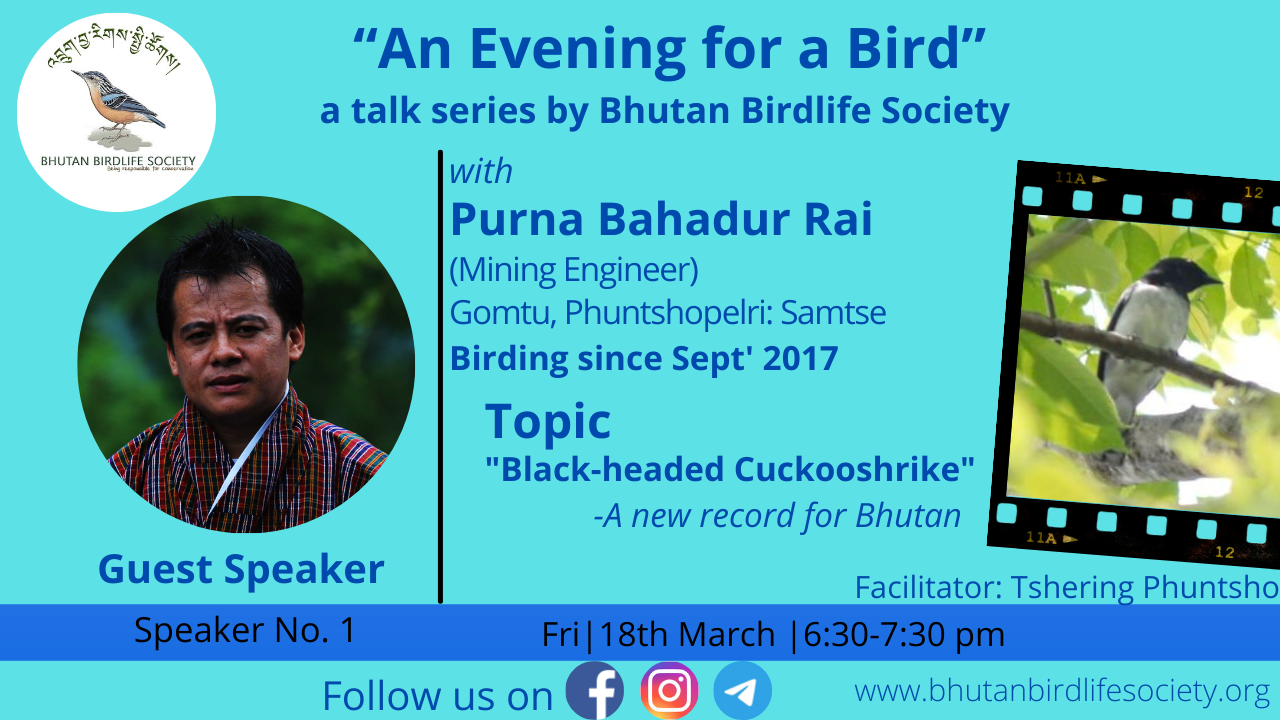
I was invited for a talk on my new bird species record to Bhutan by Bhutan Birdlife Society (BBLS) that was scheduled on 18th March, 2022 evening 6:30 to 7:30 pm BST. The Webinar Series- An Evening for a Bird was initiated by BBLS to exchange knowledge and information among the members about the birdlife in Bhutan. It is to promote citizen-science and environmental stewardship of the members through networking and friendship. The platform was conceived by the core members in 2020.

It was an honor for me to be the first Guest Speaker of the Webinar Series hosted by BBLS. I was excited and nervous at the same to share my story. The patron of BBLS Dasho Benji graced the Webinar. The Webinar went well with much appreciation from Chairperson, the members and the participants.

The BBLS Project Manager, Mr. Yeshey Dorji welcomed all the members and the participants for this first ever Webinar Series Talk followed by the facilitator, Mr. Tshering Phuntsho on the background of this very concept of the Webinar and also introducing the speakers. Dasho Benji gave an opening remarks to all the participants and was really touched by the passion of young birders for conservation.  

After the opening remarks, the facilitator handed over me the screen. I thanked him and wished Patron, Chairperson, BBLS members and the participants a very good evening. I also thanked Bhutan Birdlife Society for inviting me for the first Webinar Talk among other talented birders and the experts in the group.


My Introduction

I introduced myself to the audience. I am Purna Bahadur Rai. I have a B.Tech Mining degree from National Institute of Technology (NIT), Rourkela, Orrisa, India and by profession I am a Mining Engineer. I have been birding for the last five years now. My favorite bird is Wallcreeper (Tichodroma muraria). This bird species has close habitat association with my work place as it is the winter visitor to my mining site. The mining has positive impact on habit creation for this species among others who love to forage in the open dry and degraded areas unlike other species. Thus, this is a significance of this bird to my profession. My total bird count so far is 240 species which I have the photographic record shots of each species. My talk was on the new bird record to Bhutan which I first sighted on 19th May, 2021 in my residential area at Nyoenpaling (Pugli-B) under Phuntshopelri Gewog, Samtse.


My Personal Journey in Birding

I shared my personal journey to the audience before my main talk. I started birding five years ago (2017) when my cousin (Mr. Sancha Rai~Teacher) introduced me to the Birds of Bhutan (BoB) Facebook page group. Since then, I kept posting my record to Birds of Bhutan group and in 2019, we published a short article of my favorite bird Wallcreeper in our (PCAL) annual newsletter. The BoB members and birders were impressed with my passion and interest in birding. My friend Tashi Tshering, a Sr.Forest Ranger gave me a courtesy call and invited me to join the Dragon Birding Amigos (DBA), an avid birders group of Samtse.

Thus, joining DBA was a great journey and there after we went birding in group hunting some rarely found species like Hooded Pitta (Pitta sordida) in Kalapani areas, Phuntshopelri, Samtse. The rediscovery of Eurasian Sparrowhawk (Accipiter nisus) from Noyenpaling (Pugli-B), Phuntshoeplri after one and half decade was astonishing. The earlier record was by P. Spierenburg in 2005 from Samtse. The publication of a book-A Guide to the Birds of Samtse 1st edition was another big achievement for DBA team in 2020.

The year 2021 was more fruitful for my birding journey despite pandemic and a dream come true moment to add a new bird species to Bhutan. It was a Black-headed Cuckooshrike (Lalage melanoptera) which I recorded from Nyoenpaling (Pugli B), Phuntshopelri, Samtse on 19th May, 2021. It was during the lockdown period that I heard a unique bird call in my kitchen garden. I scanned for two days and on the third day I was fortunate to take a record shot. I shared to my amigos and BBLS members. They confirmed it as new record to Bhutan. Other species like Dark-sided Thrush (Zoothera marginata) from Pendenling (Gomtu) which is also a third record to Bhutan as per the experts and Dusky Thrush (Turdus eunomus) are new to Samtse birds’ list. We also presented a paper on Samtse’s Song Birds (An Annotated Bird Checklist for the Selected Regions of Samtse recorded between 1 September and 31 December 2020) to Bhutan Ecological Society (BES). The year was fulfilling amid the pandemic.


Dragon Birding Amigos (DBA) Team

We are an avid birder from Samtse and Thimphu from diverse backgrounds but with same passion in birding and conservation. We are a teacher not just in four walled classrooms but in the wild with nature. We are a forester not just in dress but in the field of action for nature. We are a financial manager not just a broker but who invest in nature conservation. We are a nature guide not just for the tourist but for all the nature lovers. We are an office assistant not just in office but assisting the team of conservationist. We are an engineer not just only for the humans’ infrastructure development but for the balanced eco system. We are Dragon Birding Amigos (DBA).


Black-headed Cuckooshrike (Lalage melanoptera)-New record to Bhutan.

Identification:

The Black-headed Cuckooshrike has a dark slaty-grey head, neck and upper breast. It has pale grey body and wings are darker grey than the mantle with white belly. It is a medium sized Cuckooshrike measuring 18 to 20 cm in length and weighing 25 to 35 gram (Birds of India). The female lacks the black hood and has a whitish supercilium, brownish gray upperparts with lightly barred back and rump. It has buff-white underparts with wide brown bars. The juvenile and immature is similar to female with an upperparts barred white (ebird.org).


Distribution:

This species is distributed in the Indian Subcontinent and Southeast Asia (Wikipedia, 2021). The closest record of this bird to Bhutan is from Darjelling (27.1N, 88.7E) and Puruliya & Bankura (23.3N, 86.0E) in West Bengal, India in 2015 and 2019 respectively (eBird Observation Dataset (n.d)).

It breeds in Northern India (in Punjab and Uttar Pradesh) and Myanmar (avibase, n.d.). It is a migratory bird in Assam. It habitats mostly in light deciduous forests and open broadleaved secondary growth forests in the plains and hills up to 2,000 masl (India Biodiversity Portland, n.d.). This means we can expect this species in higher regions of our country not just in southern belt of Bhutan. The study claims that the lowlands birds are moving upwards in the highlands. (How new bird species arise-https://phys.org/news/2022). Thus, one should not be surprised to see this species in Thimphu or other regions of the country in future.

Its status as per the International Union for Conservation of Nature (IUCN) is Least Concern. It has a stable population as per BirdLife International 2017 and has no population surveyed carried out yet. This species mainly feeds on insects, moths, caterpillars, cicadas, butterflies, crickets, beetles, grasshoppers and they occasionally feed on fruits, figs and berries (https://indianbirds.thedynamicnature.com/).


Location:

This species is first recorded in Bhutan from PCAL, Pugli colony, Nyoenpaling (Pugli-B) under Phuntshopelri Gewog in Samtse. The geo-coordinates of the area is 26°49'26.68"N, 89°13'33.35"E. The Nyoepnaling (Pugli-B) is located at an elevation of about 405 masl. The record shot was taken on 19th May, 2021 during the lockdown period. I was in kitchen garden when I heard its call two days before the record shot. I was scanning the area for the new call and on third day, I could finally photograph the bird on a teak tree top. Thus, a mining engineer landed up discovering new bird record to Bhutan instead of stone or minerals. That doesn’t mean that I am not carrying out my entrusted job but I explore both in the field.


Challenges in Conservation of the Birds Species

Watching birds is a beautiful journey but there are challenges on the way in its conservation. We human have become so selfish that we are taking away more space than what we actually need. We are moving from survival to the path of extinction sooner or later in the name of comfort and modern development. Our very own infrastructure developments like roads, dams, power lines, buildings, etc are direct or indirect threat to the birds/avifauna and other living being on this only planet Earth.

Similarly, the extractive industries like mining/quarrying, dredging, deforestation, sand extraction and expansion of agriculture are the areas where we need to develop in unity without having to comprise the lives of flora and fauna. The forest fires are another reckless human error and sometimes even intentional for fodder grasses. We can minimize all these threats and practice eco-friendly activities with the passionate heart of belongingness for every lives on this Earth.


Conservation Efforts by Mining Personnel and Companies or Industries

As a mining professional I ought to protect the environment as much as I exploit. It is the mandate of the mining companies to reclaim the mining site to its near natural state into vegetation if not at all to the landscape of its initial virginity. We try to bring back its former glory by reclaiming the mined out areas so that the flora and fauna can once more thrive in its kingdom.

For example, the above artificial vernal pool we created in one of the reclaimed Mines in Phuntshopelri, Samtse is attracting birds and wild animals. The Dusky Thrush which is new record to Samtse was recorded by the side of this vernal pool. Likewise, we choose the plant species which attracts birds with its flowers and fruits just in the pictures above. The Ficus religiosa or pipal tree grows in a degraded area and its fruits are diets for many birds. The next tree species we have planted is the Coral tree/ Erythrina is a fast growing species in this region and its flowers attracts various birds’ species as in the picture above.

This is how the miners and the mining companies take care of the environment around and always have a heart in action for conservation. We try our best to practice eco-friendly mining right from operation to end of mine life to restore it and give it back to the nature.


Conclusion

To conclude, I would like to urge all the young minds let’s not leave the conservation works to only those are paid for it. It is our moral and social responsibility as a human being on this planet to conserve the nature. Our common goal and objective is to live healthy and share this only green planet Earth with other species. Our coexistence and interdependence with other species is the law of nature and we can’t deny it. It is our universal religion of life on Earth.

Any one of us irrespective of our background can be a conservationist or environmentalist in our own small way. From farmers to doctors to engineers, we can showcase the conservation efforts from our fields for nature. The industries and companies does practice eco-friendly operation but without an active employee or the leader with nature loving heart, the environmental mandates may be compromised.

The awareness and implementation of conservation for balanced eco-system will naturally start when we have people in the industries or organizations with passion in birding or conservation acts. The industries and institutions ought to play proactive roles in conservation than the conservation organizations in reality. Our developmental activities are to be aligned with the philosophy of Gross National Happiness (GNH). The Conservation of Nature is the strongest pillar among four of them for us. We must be a responsible citizen of a Carbon Neutral Nation in the world.

The very foundation of Bhutan Birdlife Society (BBLS) is based on the three principles (Birding, Passion and Conservation) I have highlighted. The founders and the members are from different background but with the same passion in birding and towards its conservation works. When we put passion in our works, the magic begins there. Be it small or insignificance, it makes greater sense. This is the very reason that BBLS could emerge to its stage within a short period of time from owning an authentic data collection app-Epicollect5 to launching a monthly journal to its own website.

This is the message I wanted to share with you all and thank you so much for listening to my story. A story of a Miner.


Q&A

Q: How do you manage your work time and birding? What is the frequency of birding per week?

A: Birding is not about tight scheduled activities. You can watch bird anytime of the day you want whether you are working or travelling. For example, we can watch birds from the room through the doors and windows. In fact, I started birding from my kitchen simultaneously cooking my meals. I watch them when I go to my work site at Mines and click them through my moving car way back to home from office. I do it in weekends. Thus, it gets managed naturally. I didn’t go looking for the Black-headed Cuckooshrike in the forest but it came to my garden. You just have to be alert and be cautious.

Q: How does mining benefit the habit restoration of some birds’ species?

A: As I have shared earlier, some birds’ species like Wallcreeper, Wagtails, Thrush, Redstarts, Pipit, Nightjars, etc habitats mostly in open and degraded areas like mining sites. The mining areas often becomes their feeding grounds and habitats for such species. When we talk about mining, all the areas won’t be desert dry. Except in the active mining benches or areas, the other adjoining spaces would be with some bushes and growing stages. We take progressive restoration of the abandoned areas or mined our areas as scientific mining approach. This is what we called it eco-friendly mining.  

Q: Which guide book and bird identification app would you recommend for a beginner birder?

A: I may not give you the right answers for this questions as I have never used one properly. I am using one filed guide book by Bikram Grewal & Garima Bhatia, A Naturalist’s Guide to the Birds of India- (Paistan, Nepal, Bhutan & Sri Lanka). However, the Birds of the Indian Subcontinent by Richard Grimmett, Carol Inskipp and Tim Inskipp would be best as many birders use this for ID and as a field guide book. While, on the app part I am not sure but you can try Merlin Bird ID by Cornell Lab. However, field guide book and experts would be better for any ID confirmation. 


A Webinar Video for those who have missed the live!

Find the Webinar Link here!https://youtu.be/b0pVKj7MpM4


Biujinay Sapna

Aaju Pani Aayau Sapanima Kina Aucha Ra Pheri Biujauna  Billaita Jhanchau Bipani Shanghai  Anh Baru Sakchau Bhanay Auunata Bipanimai  Katai T...